

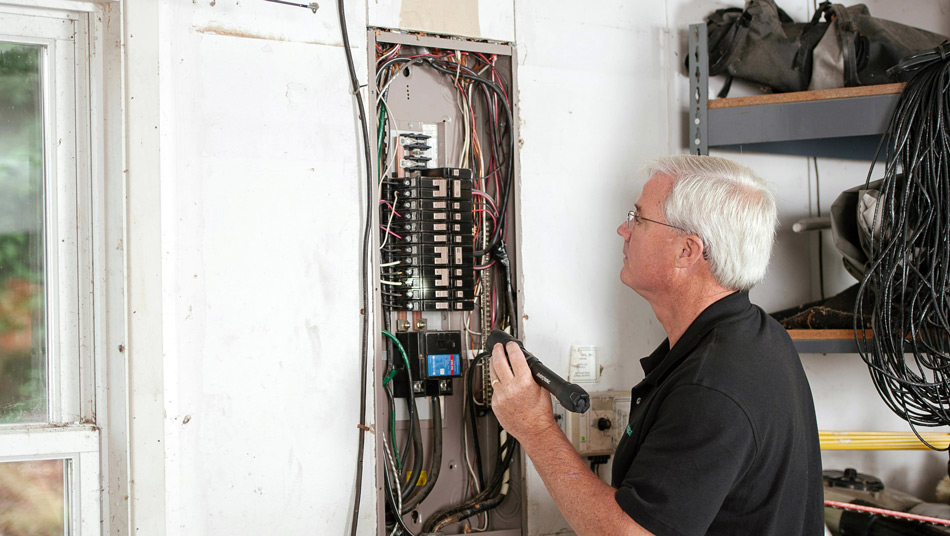
The electrical panel in most American homes was designed to meet the load requirements of the era in which it was installed. A 100-amp service panel configured for a 1970s household carried a refrigerator, a few light fixtures, a window air conditioning unit, and perhaps a clothes dryer. It was adequate for what existed at the time. That same panel, in a home that now powers a high-efficiency heat pump, a dishwasher, a home office, an array of smart home devices, and a Level 2 EV charger, is operating in a fundamentally different environment.
Panel capacity is not something most homeowners think about until a circuit breaker trips repeatedly, a contractor says there is no room to add a new circuit, or a home inspection flags the panel as a concern. At that point, the question shifts from theoretical to immediate.
How Panel Capacity Is Measured
Electrical service is measured in amperes (amps). Most homes built before 1990 were wired for 100-amp service. Homes built during the 1990s through the 2000s often have 150- or 200-amp service. New construction today frequently specifies 200 amps minimum, and 400-amp service is increasingly common in homes where EV adoption, heat pump systems, and all-electric appliances are standard planning assumptions.
Amperage capacity determines how much total electrical load can be drawn through the service entrance at any given moment. In practice, not every circuit runs at its rated maximum simultaneously — load diversity means real peak demand typically falls below the theoretical panel ceiling. But as more high-draw devices are added to a home over years, the margin between peak demand and panel capacity narrows progressively.
The number of available circuit breaker slots in the panel is a related but distinct constraint. A panel may have physical room for additional circuits but insufficient amperage to support them under load. A panel may also have adequate total amperage but no open slots. Both conditions limit what can be added, and both require assessment by a licensed electrician to address correctly.
The Modern Load Additions That Are Changing the Math
Several appliance categories introduced or widely adopted in the past decade have materially changed residential electrical demand.
Electric Vehicle Chargers
A Level 2 EV charger typically operates on a 240-volt, 40- to 50-amp dedicated circuit. That single circuit represents 40 to 50 percent of the total capacity of a 100-amp panel when running at full draw. For homeowners with a 100-amp service, adding an EV charger without a panel assessment is not a straightforward installation — it is a load calculation problem. Our electrical installation team evaluates existing capacity, identifies whether a service upgrade is required, and completes the charger circuit as a fully permitted installation.
Heat Pump Systems
Heat pumps have replaced gas furnaces in a growing share of Missouri homes, particularly in new construction and in homes undergoing full HVAC replacements. A heat pump system requires a dedicated 240-volt circuit, and its amperage draw at compressor startup is meaningfully higher than steady-state operation. Pairing a new air-source heat pump with an undersized panel or an overloaded circuit creates both performance problems and safety risks. A proper load calculation before installation determines whether the existing panel can absorb the new system or whether a service upgrade is part of the project scope.
All-Electric Appliance Conversions
Homes originally configured for gas appliances — ranges, dryers, water heaters — that are converting to electric counterparts require new 240-volt dedicated circuits for each appliance. Induction ranges, heat pump water heaters, and electric dryers each have specific amperage requirements. Homes making this transition in Florissant or St. Charles often discover that the panel was never sized to carry multiple 240-volt appliance circuits simultaneously. In those cases, a subpanel installation or full service upgrade is the appropriate solution.
Persistent Baseline Load from Smart and Always-On Devices
Home office equipment, smart home hubs, streaming devices, security systems, and always-on appliances add a persistent low-level load that panels installed decades ago were not sized to carry continuously. Individually, each draw is small. Aggregated across 15 to 20 devices operating 24 hours a day, the collective baseline can consume a meaningful portion of a circuit’s rated capacity and contribute to cumulative thermal stress on aging wiring and breakers.
What Frequent Breaker Trips Are Actually Telling You
A circuit breaker that trips repeatedly is doing its job correctly: protecting the wiring from a current it was not rated to carry. The underlying condition it is responding to, however, is worth diagnosing rather than just resetting.
A breaker trips for one of three reasons: the circuit is overloaded by too many devices drawing too much current; there is a ground fault, meaning current is following an unintended path to ground; or the breaker itself is mechanically failing and no longer holding its rated threshold reliably.
Persistent trips on a single circuit that serves a fixed set of devices usually means the circuit is undersized for its load. The resolution is either a higher-rated circuit with appropriate wiring gauge, or redistributing the load across multiple circuits. Trips that occur randomly across several circuits, or a main breaker that trips, can indicate a problem at the panel level itself. Our electrical repair team can trace the root cause and determine whether the fix belongs at the circuit or the panel.
Panel Age and Brand: What St. Louis Area Homeowners Should Know
Panel age matters beyond amperage capacity. Federal Pacific Electric Stab-Lok panels and Zinsco panels — installed in large numbers in homes built from the 1950s through the 1980s — have documented failure modes that include breakers that do not trip under fault conditions. The consequence is that the wiring they are supposed to protect can overheat without the breaker interrupting the circuit.
Homes in Florissant, St. Charles, and surrounding St. Louis County communities built before 1985 have a statistically higher probability of containing these panel types or wiring configurations that would not meet current National Electrical Code (NEC) requirements. That does not create an immediate legal obligation to upgrade an existing owner, but it is information that changes the risk calculus — particularly before adding new circuits or increasing load on an already aging system. A licensed electrical inspection can identify panel type, condition, and realistic remaining service life.
Whole-Home Surge Protection: The Panel Addition Worth Considering
A panel upgrade or service increase is an appropriate time to add whole-home surge protection. Unlike plug-in strips that guard one circuit endpoint, a panel-mounted surge protector guards all connected circuits simultaneously against voltage spikes from lightning, utility grid switching, and large motor loads cycling on and off. Given the cumulative value of the electronics, smart appliances, and home systems in a modern residence, this is a low-cost addition relative to what it protects — and it eliminates the need to track which individual outlets have strip protection and which do not.
Getting an Accurate Assessment Before You Add More Load
Panel capacity is not a subject that lends itself to self-diagnosis. The conditions that matter — actual load calculation, service entrance condition, grounding integrity, bonding continuity, available fault current — require physical inspection and measurement by a licensed electrician. A number printed on a breaker panel door is a starting point, not a complete picture of what the system can safely support under current conditions.
B&B Heating, Cooling, Plumbing and Electrical holds Missouri Electrical License #E32500. Our electricians serve homeowners across Florissant, St. Charles, and the greater St. Louis metro area. If you are planning an EV charger installation, an HVAC upgrade, a major appliance conversion, or a home addition that requires new circuits, the right starting point is an honest evaluation of what your current panel can support and what it would cost to expand that capacity correctly.
Explore our full range of residential electrical services or contact us to schedule an assessment.
Florissant: 1955 Washington St., Florissant, MO 63033 | Phone: 314-668-8530
St. Charles: 2115 S Old Hwy 94, St. Charles, MO 63303 | Phone: 636-452-9396
Email: bbhvac1955@gmail.com